E Ink: A Tale of Two Applications
Last week, in explaining why I was underwhelmed by the Sony Reader, I mentioned E Ink. It’s a display technology that uses tiny microcapsules that can be controlled like pixels. Once the microcapsules are arrayed into an image, they require no further power; they continue to display using reflective light.
In its current state of development, E Ink was not compelling to me in the Sony Reader. But I’d like to offer a compare-and-contrast with a simpler application of E Ink: Lexar’s JumpDrive Mercury, a pocket USB flash drive with a percent-full gauge.
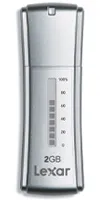
Exploiting E Ink’s “powerless display” advantage over other electronic displays, the gauge is readable whether the JumpDrive Mercury is plugged in or not. When you think about it, the only time the display can change (and thus needs power) is when the drive is plugged in (and thus has power). Nice.
Also, the JumpDrive Mercury leverages another E Ink advantage over traditional displays: the ability to be packaged very thin and light. For pocket USB flash drives, small is beautiful, and the E Ink display in the JumpDrive Mercury adds precious little mass or volume to the device.
Finally, as important as exploiting E Ink’s advantages, the JumpDrive Mercury’s use of E Ink is not penalized by E Ink’s disadvantages against other display technologies. Lack of color and a slow screen refresh are not a big deal for a gauge on a USB flash drive. In contrast, they are problems for the Sony Reader, which is potentially competing with colorful, instant-refreshing LCD devices that can do a lot more (like multimedia) on top of e-book reading.
So, although the JumpDrive Mercury does less with E Ink than the Sony Reader, what it does, it does well.