How Band Names Went Wild, 1964–1968
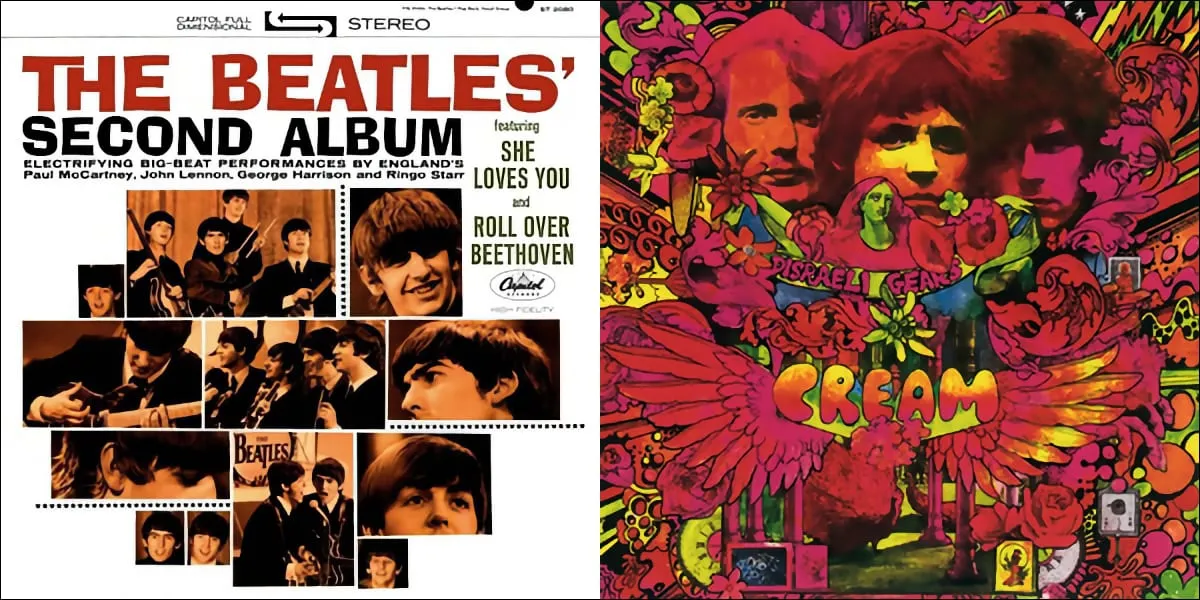
From 1964 to 1968, popular band names went from a single dominant formula to a linguistic free-for-all. The Beatles, The Beach Boys, and The Supremes were joined by Iron Butterfly, Strawberry Alarm Clock, and Cream. This is the story of that four-year burst of invention.
1964
Of the bands that appeared on the Billboard singles and albums charts in 1964, two in three had a name beginning with “The” and ending with a plural noun. The Angels, The Animals, and The Astronauts represented the letter A.
Most of the remaining names also had “The” and a plural noun, but after a bandleader’s name: Booker T. & The MG’s, Cliff Richard And The Shadows, Gladys Knight And The Pips.
Another twist on the main formula was to use a pluralized adjective: The Superbs, The Radiants, and The Dynamics—all soul/R&B vocal acts. Instead of answering the question, “What thing are they?” their names answered “What are they like?”
Less directly, nouns could also evoke what a band was like. Girl groups often had feminine nouns (The Chiffons, The Crystals) or diminutive endings (The Marvelettes, The Ronettes, and The Shirelles). In contrast were The Trashmen, The Kingsmen, and The Bachelors.
With all these cases, the name presented the band as a specific group of people. The Zombies were not just any zombies; they were The Zombies. A band member was a Zombie.
This naming formula went back to when the modern pop group emerged in the 1950s. In this and many other ways, 1964 had more in common with the decade before it than with the upheavals that would define the years ahead. The counterculture was still in the underground. Beatlemania was in full froth, but The Beatles of 1964 wore matching suits and wanted to hold your hand. It would be only a few years until they—and many newer bands—wanted to expand your mind instead.
1968
The Billboard charts of 1968 had band names that, in 1964, would have seemed like they were from another universe: Blue Cheer, Clear Light, Deep Purple, Electric Flag, Fever Tree, Grateful Dead, Iron Butterfly, Jefferson Airplane, Moby Grape, Pink Floyd, Procol Harum, Rotary Connection, Ultimate Spinach, and Vanilla Fudge.
These names were a new formula: two words, no leading “The,” no plural noun, obscure meaning.
1968 also had a one-word formula: Cream, Flavor, Grapefruit, Nazz, Orpheus, People, Rejoice!, Rhinoceros, Spirit, SRC, Steppenwolf, and Traffic. 1964 had no bands with one-word names in the Billboard charts.
Another 1968 difference was “The” names ending with a singular noun: The 5th Dimension, The Balloon Farm, The Crystal Mansion, The Epic Splendor, The First Edition, The Jimi Hendrix Experience, The Love Generation, The Lovin’ Spoonful, The Rose Garden, and The Scaffold. 1964 had no names like this, except a few whose singular noun referred to an ensemble (“Band,” “Trio”).
All these 1968 names violated the earlier group-description rule that a Zombie was a member of the Zombies. In contrast, a Traffic was not a member of Traffic. The new names referred to concepts, sensations, places, literary allusions—almost anything other than the band members.
Alongside the new names, the classic naming formula was still well-represented on the 1968 charts. Partly this was due to bands from 1964 and before staying on the charts, as with The Beatles, The Rolling Stones, and The Temptations. But newer bands also adopted the classic naming formula. Some did so straight, with names that would have sat comfortably in the early 1960s: The Box Tops, The Foundations, The Four Sonics, Mitch Ryder And The Detroit Wheels, The Sandpipers. A few infused the form with later-1960s stylings: The Electric Prunes, The Lemon Pipers, Big Brother And The Holding Company, Country Joe & The Fish. And finally, a name like The Doors could work both ways. On its face, it was a 1964-esque name, an ordinary plural noun following “The.” But to those who knew its connection to Aldous Huxley’s The Doors of Perception, it was fully 1968.
So the rise of alternate naming forms did not mean the fall of the old way, but a new channel of expression had opened. As a whole, band names were a stranger brew—wildly more diverse and creative than four years earlier. Although it’s tempting to over-associate this with psychedelic music, the trend touched many genres. The bands mentioned above ranged in style from bubblegum pop to heavy rock, blue-eyed soul, Detroit R&B, blues-rock, baroque pop, and more. Psychedelia was only one strand among many, although it produced the most out-there names like Strawberry Alarm Clock.
As we close our magical history tour of band names, it’s worth pausing on Strawberry Alarm Clock. You might expect that the name came to the band in a tripped-out vision. Actually: “Our record company kind of picked our name for us. They wanted to use ‘strawberry,’ because I guess it was just a sign of the times. Peace, love and strawberries! So, that was already picked out.”
Put another way, the counterculture was appropriated for commerce almost as fast as it was created. A 1968-esque band name could represent both an act of defiance and a marketing decision. It couldn’t be any other way, because we have been talking about Billboard-charting bands—by definition, they had at least some commercial impact. That was true in 1964 too.
What changed was the commercial viability of breaking from the norm. In 1964, bands succeeded with matching outfits and a single naming formula. By 1968, the counterculture had created a market for bands that looked, sounded, and named themselves like nothing from four years earlier. This was more than the market’s usual appetite for something new. It was a radical extension of where “new” was allowed to go. The names tell the story.
For the full lists of bands that appeared in the 1964 and 1968 Billboard charts, as well as the methodology for creating the lists, see Bands on the Billboard Charts: 1964 versus 1968.