Americans Agree
Americans Agree is about policies that majorities of Democrats, Republicans, and Independents agree on. The project was active between July 4, 2025 and July 4, 2026. In that time, it tracked one hundred points of agreement in national opinion polls, including within seemingly intractable issues like abortion, immigration, and guns.
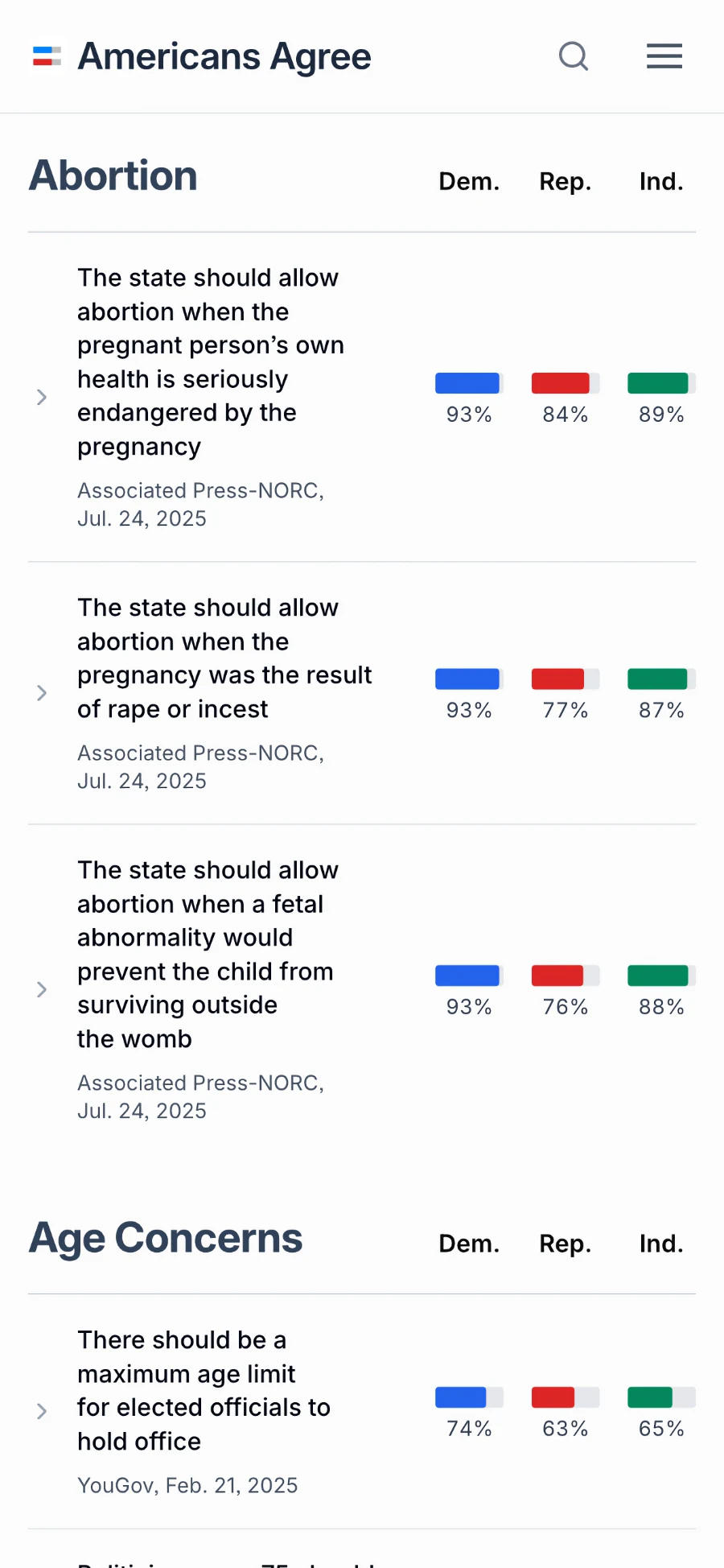
The website’s home page lists the points of agreement by topic area:
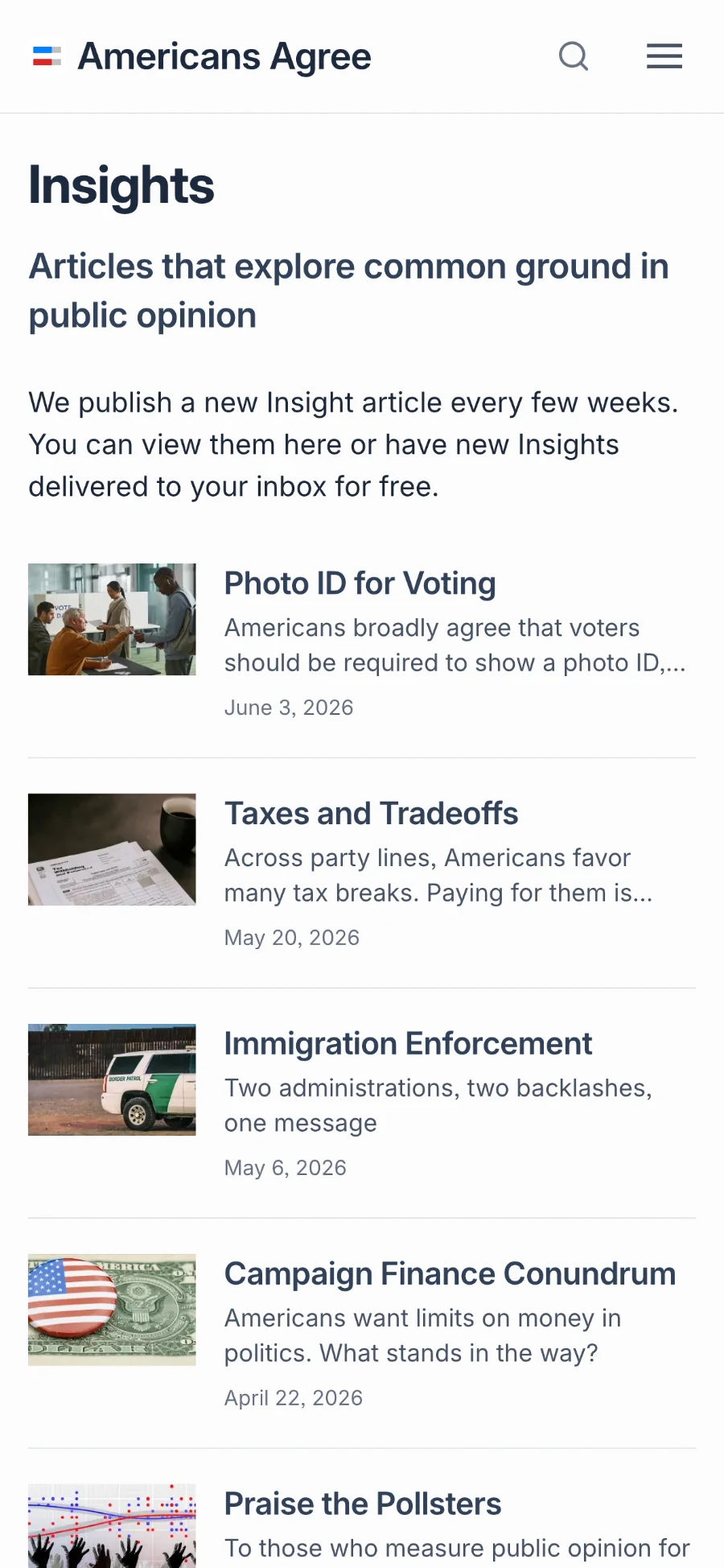
The site also has 26 Insights articles, which explore whether, why, and how different points of agreement have or have not become law:
I created Americans Agree because our media and politicians often emphasize what divides us. I wanted to know how much common ground there actually is, circa 2025–2026, a very divided time.
When I shared an initial list of agreement points, the typical reaction was:
- “That’s a lot more than I would have thought.”
- “I agree with most of it.”
- “Why have I not heard about this?”
That last comment, which I heard many times, convinced me to do the Americans Agree project publicly rather than as a quick internal query for myself. And once I got going, it became apparent that answering one question—what do people agree on across party lines?—raised another question: why haven’t many of these agreement points been enacted into law?
The answer varied by topic:
-
Some agreement points actually did make it into law, and their stories were instructive—for example, a bipartisan abortion bill in Texas.
-
Others had real chances of getting there, such as bans on congressional stock trading, artificial food dyes, and social media for younger kids.
-
Others were blocked by high constitutional hurdles, such as age limits for elected officials and term limits for Congress.
-
Others were blocked or made more contentious by advocacy groups whose incentives are often to fight rather than problem-solve.
-
Others seemed appealing but upon closer inspection were far from obvious wins—for example, year-round daylight saving time or Election Day as a national holiday.
Researching and writing about these topics was an enlightening experience. The intersection of public opinion and policy is a complicated place.
A year into the project, the list of agreement points had become stable. A new agreement point or two would appear each month; once in a while, a new poll would negate a previous agreement point. The “Insights” articles had covered almost every major topic area. The original questions behind the project were largely answered.
So on July 4, 2026—one year after the first “Insights” article—I published the last article, Lessons from a Year of Exploring Common Ground. The website remains up, frozen in time as of July 4, 2026, a reminder to those who find it later that Americans of different political stripes can agree on more than the headlines suggest, and that those patches of common ground can be built on.