The Beauty of “I Cut, You Choose”
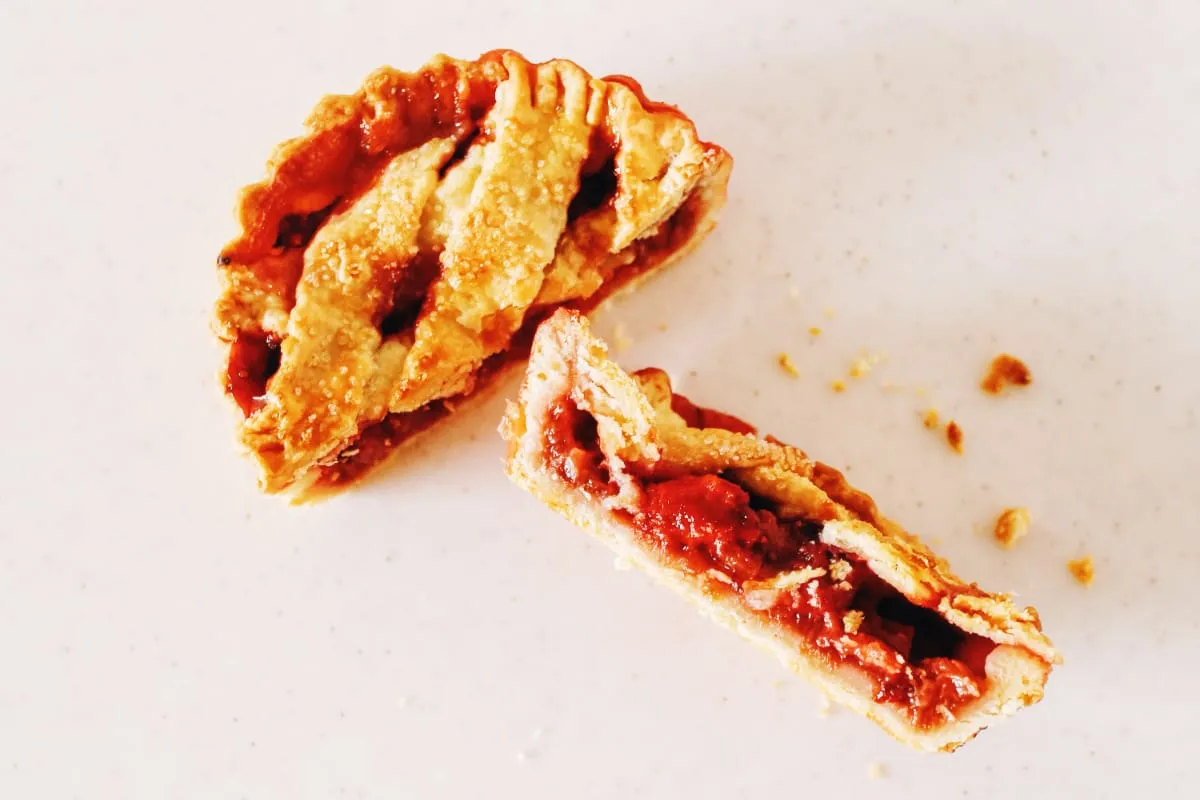
As beautiful solutions go, it’s hard to top “I Cut, You Choose.” Picture two kids trying to share a pie. Neither trusts the other to cut it fairly. But if one cuts and the other chooses, neither has reason to complain about what they get. Although it might seem like a trivial trick, “I Cut, You Choose” is a profound, elegant idea. It can be used not just by kids with pies but to resolve disputes with far larger stakes.
A Tale of Two Pie Pieces
Here is a simple “I Cut, You Choose” (ICYC) scenario. We have two kids, a brother and sister, and a pie that looks like this:
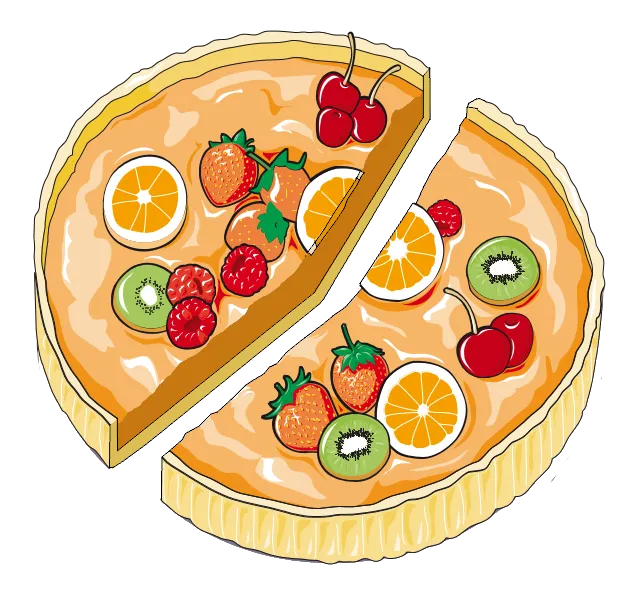
The brother has cut, and the sister will choose. He used a bent cut: the piece on the left is smaller, but it has more and bigger raspberries. He cut this way because he’d be equally happy to get less pie with more raspberries or more pie with fewer raspberries.
The sister takes the piece she prefers. Because she got her pick, she has no reason to envy her brother. And because either piece suits him, he has no reason to envy her. Mathematicians call this an envy-free division.
Notice what was not required. The kids didn’t need to agree on what makes a piece valuable. They didn’t need a referee. They didn’t even need to trust each other. The rules themselves made a fair division possible.
When the Pie Is a Business
Imagine Alice and Bob, two equal partners in a business. They’ve had a dispute and want to go their separate ways. But the business can’t be cut in two. Instead, one partner must buy out the other, paying half the business’s value.
There is a way to do this known as a shotgun clause. Alice names a price for Bob’s half of the business. Bob then chooses: sell at that price, or buy Alice’s half for the same amount.
Suppose Alice believes the business is worth $1 million. If she names a price of just $300,000 for half the business, Bob can turn the tables and buy her out for that amount. Conversely, if Alice names an inflated price, like $700,000 for half the business, Bob can happily sell his half at that price.
It’s ICYC at work. Alice must be prepared to be on either side of the deal. As a result, her smart move is to name a fair price.
When the Pie Is the Ocean Floor
Most of the ocean floor is beyond national boundaries. Should anyone be able to explore it for valuable minerals? And what about countries that lack the resources to do so?
The United Nations Convention on the Law of the Sea has a clever answer. If an applicant wants to explore an area of the seabed for polymetallic nodules, the applicant must divide it into two parts of equal value. The International Seabed Authority then picks one to reserve for the Authority’s own mining arm or for developing countries. The applicant can receive rights to the other, subject to approval.
Sound familiar?
The applicant has probably surveyed the area and knows far more about its prospects than the Seabed Authority does. But that knowledge can’t be used to get a favorable split. If the applicant draws the line so that one part is richer, the Authority may take that part and leave the applicant with the poorer one. So the applicant’s best move is to make the two parts as close in value as possible.
Note that we’re now talking about international law and mining investments potentially worth billions of dollars, yet it’s the same principle the two kids used to split dessert.
When the Pie Is Society
Let’s push this further still. Suppose what’s being divided is everything: the rights, opportunities, income, and wealth of an entire society. Who cuts? Who chooses?
The philosopher John Rawls gave a famous answer that shares a key idea with ICYC. In A Theory of Justice (1971), he asked readers to imagine choosing the basic principles of society from behind a veil of ignorance. For example, how unequal should incomes be allowed to get if you don’t know whether you’ll be rich or poor? Because you could end up as anything, you have a strong incentive to design a society you could accept from any position within it—especially, Rawls argued, the worst one.
In an important way, that’s like the cutter’s situation. You need to decide based on what would be acceptable across all possible outcomes. The difference is that the “chooser” isn’t a rival. It’s the luck of birth and circumstance.
There’s no objective answer to how society’s pie should be divided, and no consensus among subjective opinions. Rawls’s insight was that we may not need those. If the procedure is fair, the outcome is fair, whatever it turns out to be.
A Thing of Beauty
The mathematician G. H. Hardy once tried to define what makes a mathematical proof beautiful. Describing two of his favorite proofs, he praised their “very high degree of unexpectedness, combined with inevitability and economy.” Although ICYC is a procedure, not a proof, Hardy’s criteria are still enlightening.
Unexpectedness: Hardy marveled that the tools in his favorite proofs seemed “so childishly simple” compared with what they achieved. ICYC is literally child’s play, yet it can also divide a business or the ocean floor.
Inevitability: Each side can guarantee itself a fair share, whatever the other does.
Economy: One cut, one choice. No measuring and no appeals.
Those are the qualities a mathematician would admire. But ICYC also has a kind of beauty that no proof can have: a moral one.
That beauty comes from reciprocity. It’s like the Golden Rule (“treat others as you wish to be treated”) but self-enforcing. ICYC doesn’t ask the cutter to treat the chooser as he’d want to be treated. It makes him do it, because he might end up with either piece. Fairness comes from the rules, not from anyone’s virtue.
But for all its beauty, ICYC has a catch: its elegance doesn’t scale. An envy-free procedure for three people gets intricate. One that works for any number of people, with a guaranteed limit on the number of steps, wasn’t found until 2016. Still, many disputes only involve two sides, and for those, the beautiful solution is one cut and one choice.
P.S. Mathematicians usually call this topic “cake cutting.” I chose pie cutting because the earlier illustration showed it so well; it’s also the favored metaphor of business and economics (dividing the pie, growing the pie).