Review: Adam Higginbotham’s “Challenger”
Adam Higginbotham’s Challenger: A True Story of Heroism and Disaster on the Edge of Space is a history of what went wrong with the Space Shuttle Challenger. It is also about a space program trying to sustain 1960s ambitions on 1970s budgets, and a case study of how experts can incrementally accept too much risk. Higginbotham tells the story through the people who lived it: astronauts and their families, engineers and managers, and anyone else who can reveal an instructive part of the complicated whole.
“A Major Malfunction”
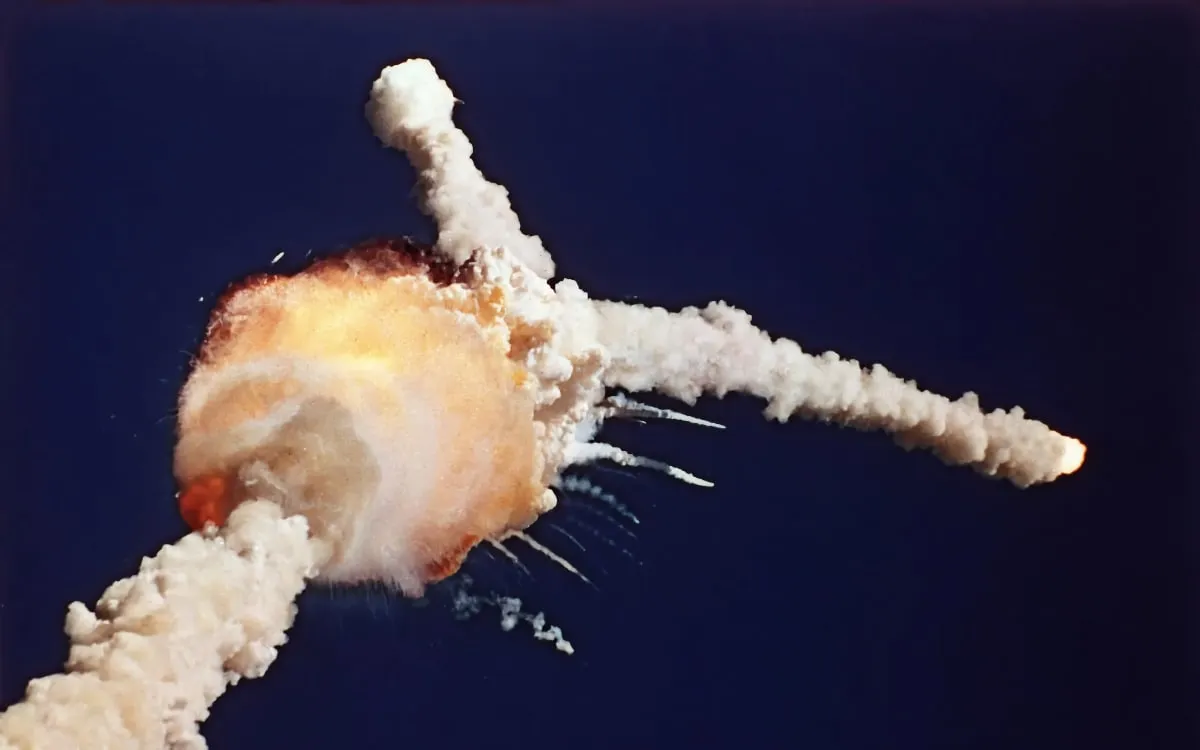
On January 28, 1986, the Space Shuttle Challenger lifted off and ascended skyward. At T+73 seconds, it disintegrated in a ball of fire.
I was living in a college dorm. I remember a room full of kids gathered around a television. The explosion in the sky replayed continuously as news anchors and reporters struggled with what to say.
In Challenger, Higginbotham starts with the catastrophic moment as it was experienced by Steve Nesbitt. A NASA public affairs officer, Nesbitt was serving as the voice of Mission Control, narrating what was happening. (“Good roll program confirmed. Challenger now heading downrange.”)
Nesbitt had just announced the latest altitude and downrange distance when he saw the fireball on a monitor. The telemetry stream on his console froze. Everyone around him was silent. He was silent.
A few moments of quiet extended into half a minute. An agonizing silence enveloped the NASA commentary loop; an eternity of dead air. On the TV screen, the cloud drifted in the wind; fragments of debris fluttered toward the ocean. The Flight Director polled his team in vain for answers.
It was forty-one seconds before Steve Nesbitt spoke again.
“Flight controllers here looking very carefully at the situation,” he said, his voice flat and impassive. “Obviously a major malfunction.”
We remember it as a moment, but Higginbotham narrates a multi-decade history of how and why it came to happen.
More with Less
The space shuttle was envisioned as launching like a rocket, reaching Earth orbit, deploying payloads from a cargo bay, and then returning to Earth like a plane. It would land on a runway and then be quickly made ready for another launch. In many respects, the engineering and operational problems were greater than those of the Apollo moon-landing program, which did not need to reuse its rockets or spacecraft from mission to mission. Yet the shuttle’s budget would be smaller. America was done writing blank checks to get a man on the moon. The shuttle program would constantly face budget constraints on its less glamorous but more intensive mission of hauling stuff to space.
Told to do more with less, NASA over-promised and under-delivered on the shuttle’s development timeline. Throughout the 1970s, delays piled up as problems emerged with new designs and technologies. Congress and the White House were losing patience. Higginbotham captures the pressure and uncertainty leading up to the first shuttle flight:
Courageous as they were, the astronauts who had flown the Mercury, Gemini, and Apollo missions all knew that their vehicles had been safely launched and checked by remote control before they ever strapped into their seats for the final countdown. But John Young and Bob Crippen would have to find out for themselves whether Columbia—with its 2.5 million working parts, 230 miles of wiring, its balky high-powered engines, experimental solid rocket boosters, and brittle ceramic tiles—was truly fit for flight on its maiden voyage. It would be the most hazardous mission in NASA’s history; [Washington Monthly writer Gregg] Easterbrook’s story warned in blunt terms how years of shrinking budgets and expedient decision-making had drastically increased the risk of a catastrophic failure, one in which the lives of astronauts would be sacrificed for a national future in space that was largely illusory. “Here’s the plan,” he wrote. “Suppose one of the solid rocket boosters fails. The plan is, you die.”
The Space Shuttle Columbia’s maiden flight was on April 12, 1981. Despite several problems, the mission succeeded. NASA’s can-do spirit was back on top, the problems reduced to footnotes. Columbia and three other orbiters (Challenger, Discovery, and Atlantis) would go on to fly 23 more missions before Challenger’s last launch.
O-Rings
Built by the rocket contractor Morton Thiokol, each of the shuttle’s two solid rocket boosters had multiple sections. The joints between the sections, and the joint where the nozzle attached, were each sealed by a pair of rubber O-rings—a primary and a backup—meant to contain the burning propellant’s white-hot gases. If both O-rings failed, the escaping gas jet would become a blowtorch that could breach the external fuel tank or sever the struts attaching the booster to it. In NASA’s parlance, such scenarios would entail the “loss of vehicle, mission, and crew.”
Higginbotham methodically traces the accumulation of evidence that O-ring failure was a real risk. As early as the second shuttle flight, a recovered booster showed that hot gas had burned into a primary O-ring. The damage didn’t appear on every flight, but it kept recurring; by 1984 and 1985, it was occurring on most flights. Each time, the problem was investigated, rationalized, and accepted: yes, it’s a problem, but it’s manageable.
After a January 1985 launch that followed unusually cold weather, Thiokol engineer Roger Boisjoly suspected that the cold had stiffened the O-rings so they couldn’t spring back fast enough to seal, making the existing problem worse; lab tests supported his hunch. In July 1985, after damage was found on a backup O-ring at a booster’s nozzle joint, NASA imposed a formal launch constraint—which was then waived flight after flight.
On January 27, 1986, with a hard freeze forecast for the launch site, Boisjoly and his fellow engineers convinced Thiokol’s management to recommend a delay of the Challenger launch scheduled for the next morning. On conference calls that night, NASA managers countered that the case for delay was suggestive, not conclusive. They urged Thiokol to reconsider.
Thiokol’s leaders caucused privately. One told his engineering VP to “take off your engineering hat and put on your management hat.” They reversed their recommendation. The top NASA officials who later gave the final “go” never heard about the dispute.
Acceptable Risk
Much of Higginbotham’s book is about the concept of “acceptable risk”:
Regardless of what the politicians might say about operating the shuttle as if it were a space-going airliner, the engineers who worked on the program understood that they had built an experimental vehicle working within the narrowest margins of safety in an unforgiving environment; flying into orbit had always required striking an often knife-edge balance between the hazards inherent in exploring the unknown, and the morally acceptable levels of diligence and safety expected of a US government agency….
The idea was that, even considering the accumulated risks of all of the millions of parts and systems in the shuttle system together, it remained a safe-enough vehicle in which to fly men and women into space. The process began years before the first shuttle flight in 1981, and continued as the program went on. It was necessarily complicated and time-consuming: a tabulation of the acceptable risks in the shuttle compiled before that first launch alone filled six volumes.
In this context, it was not crazy for the NASA managers to push back on the case to delay the Challenger launch. The O-rings were one among many problems that were long considered manageable. The shuttle had come back safely 24 out of 24 times. The O-ring risk was familiar from the many times it had been waived in the past. Some warm-weather missions also had the issue, and even the coldest mission succeeded.
But in arguing forcefully against Thiokol’s concerns, the NASA managers had done something fatefully wrong. Normally, a launch needed full confidence from everyone involved that the shuttle could fly safely. Instead, the NASA managers had shifted the burden onto the Thiokol engineers to prove the shuttle could not launch safely in the cold. By that standard, the only full proof would be catastrophic failure.
Thus was acceptable risk twisted past its breaking point.
The People Behind the Program
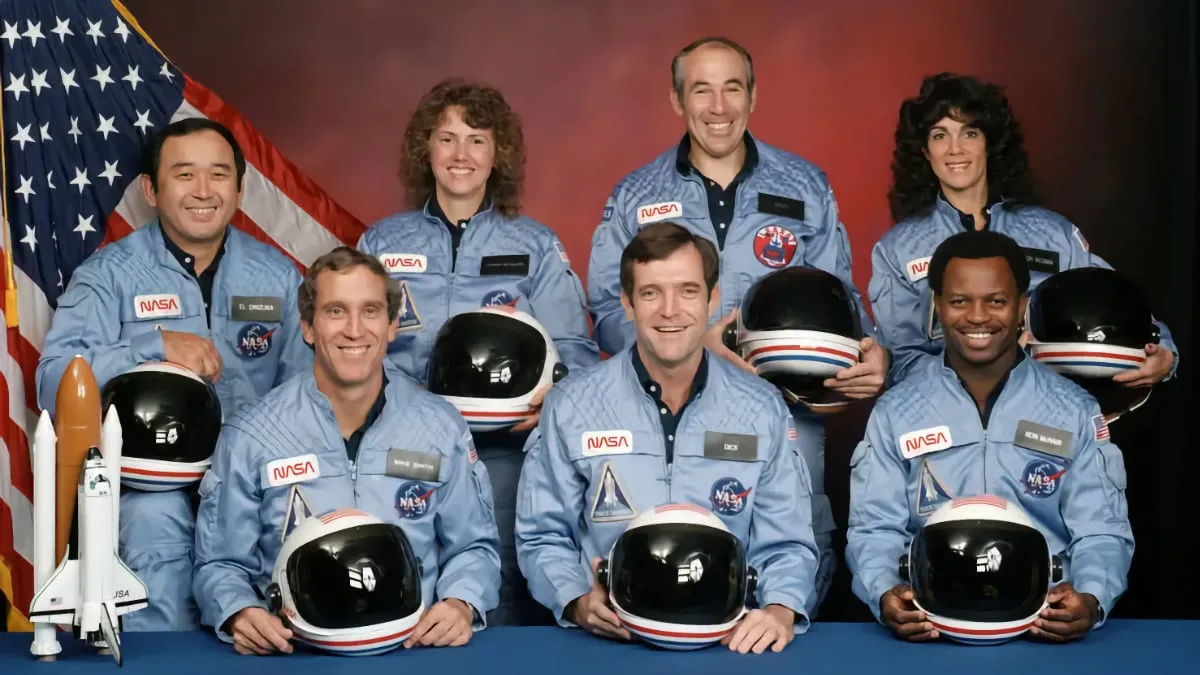
The acceptable-risk thread is central to the book, but there is much more. Higginbotham tells the stories of each of the mission’s astronauts, including Christa McAuliffe, the would-be “first teacher in space.” He brings in their families, their colleagues, and their culture within NASA. He covers the engineers, managers, and administrators—what they were thinking and doing—and the system’s effects on their actions. He covers the shuttle program’s initiatives to diversify the all-white, all-male astronaut corps to look more like America. If you’re up for that panoply of angles, Higginbotham’s writing ably carries the load.
I particularly appreciated how he conveys technical points through the experience of real-life characters. For example, he explains a particular danger by way of a Thiokol engineer whose 25 years of experience was “long enough to have learned out on the test range that there was no such thing as a small leak in a solid rocket; if a seal malfunctioned, you knew you’d soon be wandering through the desert collecting pieces of your motor in a bucket.”
Or regarding the risk of being an astronaut’s spouse, referencing the Apollo 1 fire that killed three astronauts during a test in 1967: “Martha Chaffee was in her kitchen, making hot dogs for the kids’ dinner, when she saw Michael Collins at the front door; in that moment she realized she was a widow.”
Thinking back to my own memory of the Challenger disaster, what I saw on TV didn’t seem possible. We had gotten used to manned space missions “just working.” Since the tragedy of Apollo 1 nearly twenty years earlier—before I was born—every American crew launched into space had come home. January 28, 1986, was a renewed reminder that heroes don’t always come home.