Why You Will Probably Outlive the Average Life Expectancy
The average life expectancy in the United States is roughly 75 years for males, 80 years for females. Chances are, you will exceed the number that applies to you.
Because life-expectancy numbers are often based on recent mortality rates, you might be thinking that future advances in medicine will give you an edge. While that may be true, the surprise is that you already have an advantage over the original numbers just by being alive to read this.
Think of 100,000 people born the same year as you. A certain percentage of that original population will die each year, as represented by the distribution below. (The original numbers are from the U.S. Social Security Administration, from which I derived the measures and charts on this page.)
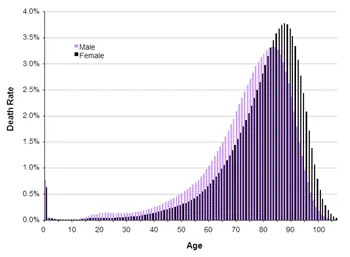
It’s not a happy thing, but each bar in the chart indicates the percentage of the original 100,000 people that died, or are projected to die, in each year. You don’t know which future bar has your name on it, but you do know that all the bars to the left of your age no longer apply to you. As a result, your current life expectancy is computed against the average of the remaining population.
In turn, that means your life expectancy is always increasing and that you have exceeded the original average practically from the beginning, as illustrated below (based again on the same Social Security data).
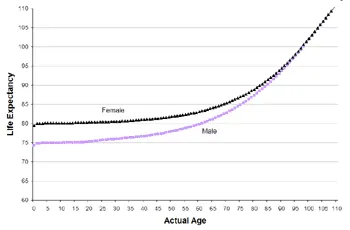
Note that if you are a 40-year old male, you’re already up more than two years from the original average. If you are a 40-year-old female, you’re up about a year and a half. And for those males that live into their mid-80s, they will have closed most of the gap in life expectancy versus females.
Of course, all this is based only on the male and female averages. Your life expectancy will rise or fall based on other important attributes. For example, if you are a chain-smoking alcoholic who lives on a Superfund site, you might want to lower your expectations.
Nevertheless, everything else being equal, this is a subject where it’s nice to know the odds are with you.
Comments (4)
Public commenting is closed. I welcome private comments or questions.
Neat stuff, Steve! Does this count as a calculus lesson?
Seems like a very useful metric for those in the business of helping folks plan for retirement.
Adam: Yes, I think this topic should be integral to a discussion of basic calculus.
Paul: The inspiration for this post was a complaint about a financial advisor getting this issue wrong. It was in the book "Fooled by Randomness" by Nassim Nicholas Taleb.
Taleb recalls a story where a TV financial advisor says something to the effect of "The average life expectancy is 75 years, so if you are 70, you need to plan on a 5 year time horizon."
Taleb's comment was something like, "What if I'm 80 years old. Should I have a time horizon of negative five years?"